
~ Delta Poetry Review ~
David Kirby Book Review by Stephen Furlong
|
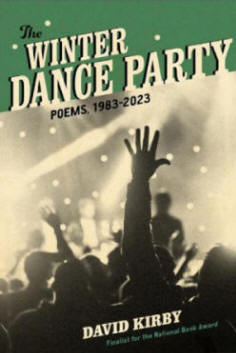
Kirby, David The Winter Dance Party: Poems, 1983-2023, Louisiana State University Press 2024. 280 pp. $34.95
To begin, I’d actually like to start at the end of the
Party, in his closing essay “Is this a saxifrage I see
before me? Or my problem with the truth (Bonus Track).”
David Kirby leads his readers on a Melvillian-like adventure
in discussing the truth in writing. As explained in the
essay, Saxifraga, which comes from Latin, literally means
“stone-breaker”; it is a type of flower known for not just
surviving, but living in harsh, stony elements.
In this closing essay, Kirby shares much wisdom, such as
this: “[T]he unknowable is built into the art by the art
itself and not by the artist.” As writers, there’s a hope
something we’ll say is immortalized forever, but Kirby
stunningly turns that idea on its head a bit, and challenges
the perspective from the ground up. Continuing, Kirby says
“Every crack in your orderly process is an opportunity for
the saxifrage to break through and burst into bloom.” Now
there’s a line: break through and burst
into bloom. And with these ideas serving as lanterns,
let us venture into the bloom that is David Kirby’s poetry.
Written across nine sections, David Kirby’s poetry takes its
readers on an adventure ranging from No One Knew Where I
Was, Including Myself to You’re Alone by Yourself
Now, Still Important to Friend, Let’s Go There –
each section containing no less than five poems which speaks
to the sheer volume of Kirby’s poetic output. In the very
first poem of the book, “Taking It Home to Jerome,” Kirby
shares an enduring idea at the end that also brightens our
poetic path:
…Sometimes, when I’m writing a poem,
I feel as though I’m operating that crusher that turns
a full-size car into a metal cube the size of a suitcase.
At other times, I’m just a secretary: the world has so much
to say, and I’m writing it down. This great tenderness.
I find the use of couplets particularly fascinating; they
build in power and focus, and invite us into Kirby’s world
of words surrounded by imagery and influence, especially as
the poem “takes it home to Jerome.”
A great strength in David Kirby’s poetry is his ability to
weave and braid narratives that begin on one line and leave
them hooked with timely punctuation that unfurls the line
into a longer connective thread of the poem. Kirby
illustrates this time and time again, but incredibly well in
his poem “More Than This.” Here’s the opening:
When you tell me that a woman is visiting the grave
of her college friend and she’s trying not to get irritated
at the man in the red truck…
Right from the beginning, a duality occurs – the poem sets
it up by two individuals doing a very individual thing:
grief. Compared to the woman visiting the grave, what does
the man in the red truck do? He “listens to a pro
football/game…much too loud.” The contrast allows readers to
see the multiplicity of the grief’s grip in real time. The
poem, housed little more than halfway through the book,
serves as embodiment of Kirby’s genius; he weaves the joy
and the terror, the clarity and the confusion. The poem
picks up steam:
…When the young men died in the mud
of Flanders, the headmaster called their brothers out
of the classroom one by one, but when the older brothers
began to die by the hundreds every day, they simply handed
the child a note as he did his lessons, and of course the
boy
wouldn’t cry in front of the others, though at night
the halls were filled with the sound of schoolboys sobbing
for the dead, young men slightly older than themselves.
The lull rhymes of headmaster and classroom,
die and by, cry and night all
push forth this section with powerful, calculated nuance.
The poem, written in a single stanza, also shows how the
horror of war can exist where “the world’s beauty breaks our
heart as well.” With that line, Kirby’s poem makes its next
move:
the old cowboy is riding along and looks down
at his dog and realizes she died a long time ago
and that his horse did as well, and this makes him
wonder if he’s dead, too, as he’s thinking this
he comes to a big shiny gate that opens onto a golden
highway…
Here the use of assonance pushes the poem further: down
and dog and ago, his and this –
the poetic maneuver effectively entangles the reader in the
narrative further. Then a twist happens: “there’s a man in a
robe and white wings… tells him it’s heaven…though he says
animals aren’t allowed,” – what?
Can you imagine that? A move that turns heaven on its head a
bit. Why wouldn’t a place that promises forever graces and
freedoms not allow pets? And yet, Kirby dares not stop the
narrative, the poem continues:
…so the cowboy keeps going till he comes
to an old rusty gate with a road full of weeds and potholes
on the other side and a guy on a tractor, and the guy
wipes his brow and says you three must be thirsty
come in and get a drink, and the cowboy says okay,
but what is this place, and the guy says it’s heaven,
Okay, now you’re probably wondering, what about the earlier
moment with the tried and true imagery – robe, wings –
reader, stay with me. Once again, lull rhyme and Kirby’s
long line illustrates the poem’s strength. For example,
side and guy, three and thirsty,
okay and place. Pushing forward:
…and the cowboy says then what’s that place down
the road with the shiny gate and the golden highway,
and when the guy says oh, that’s hell, the cowboy
says doesn’t it make you mad that they’re pretending
to be you, and the guy on the tractor says no,
we like it that they screen out the folks who’d desert
their friends.
When I tell you I couldn’t find my breath, what I mean is I
didn’t breathe right for days; this moment shows us how, to
quote the poem earlier, “the world’s beauty breaks our
hearts as well.” It’s a stunning poetic move, and once
again, Kirby’s narrative is woven with effective
punctuation. A period! His speaker wants to stop and take in
that moment. And boy do we take in that moment!
Whew.
Remember the poem’s actors in the beginning? The man and the
woman come back:
…your friend can’t take it
any more, and she turns to confront the man
who’s making all the noise, to beg him to leave her alone
with her grief, and that’s when she sees he’s been
putting up a Christmas tree on his son’s grave
and that he’s grieving, too, in his own way,
one that is not better or worse than the woman’s
just different, the kind of grief that says the world
is so beautiful, that it will give you no peace.
What an ending. No words except: Wow! Incredible! Amazing!
One of the many joys of David Kirby poems is how they serve
as a study in poetics, too, and one of the best examples of
this comes from the poem “Stanza.” Located in the section
What Are They Up To Now, Kirby serves up a powerhouse of
a poem in one stanza riddled and rhymed with genius and
grace. The poem begins:
It means room in Italian, but room itself
means both enclosed area and open space,
means confinement as well as freedom.
Right off the bat, Kirby’s focus and word choice is an
unfolding flower bud revealing new color and texture right
before our eyes. Kirby brings everything to focus with some
magic from Milosz:
… “in the very
essence of poetry there is something indecent,”
says Milosz for “a thing is brought forth
which we didn’t know we had in us,”
and we jump back “as if a tiger had sprung
out / and stood in the light, lashing its tail
The push and pull of finding exactness in language and
animalistic movement is clever – it speaks to the duality
inside of poet’s decision-making and the response itself
from those decisions. Kirby, snapping us into attention,
writes “Poet, listen to your poem!” The directness is
exactly what makes the line all the more authoritative. That
authority is then, just like the tiger prior, given into
nature, starting with water:
a stanza like a waterfall toward which
the reader floats unknowing. First there is
the river, tree lined and tranquil, then
the boulders that churn the water and whiten
it with rage, then the precipice itself,
and after that, the long flight through a mist
that hides a future of which you know nothing…
By using a standalone stanza, similar to the forementioned
“More Than This,” Kirby’s precision and focus gives way to
how things can comingle in creative, thought-provoking ways.
The river gives way to the tree gives way to boulders give
way to a new way of seeing (and feeling) water. It’s like a
wide-action shot in film, the focus begins on one thing,
then by the end of the shot, as viewers we are able to take
in all the differing elements that come together in one
piece. It’s truly a remarkable move. I don’t want to spoil
all the fun of this poem but I will say that “Stanza” is a
dizzying poem, and its ending is a testament to David
Kirby’s skill to hone in to focus and attention. Its reward
is nourishing long after the read.
The Winter Dance Party
is generous in its scope, allows a full breadth of David
Kirby’s immense poetic output and, at the end of the day,
his poetry is a gift that opens with each read. |
 One
of the most valuable lessons I took in from my first
creative writing class was also one of the most direct: Pay
Attention. Paying attention wasn’t like depositing a check
or withdrawing crisp green bills, but its value went beyond
any of that because it was your way of saying Hey, I’m here
and I got you. This seemingly simple lesson, when applied to
the poetry of David Kirby, shows us how he carves an
understanding of love through his attention to detail and
narrative direction. This is explored time and time again
through expansiveness of his lines and ideas, and oh yes,
the humor and the humanity of it all, too. It’s as though
David Kirby and his poems invite us in, sit us down at the
dinner table, and catch up with us like an old friend—but
also encourage us to look out the window, look for our
breath a little, and revel in the great unknown.
One
of the most valuable lessons I took in from my first
creative writing class was also one of the most direct: Pay
Attention. Paying attention wasn’t like depositing a check
or withdrawing crisp green bills, but its value went beyond
any of that because it was your way of saying Hey, I’m here
and I got you. This seemingly simple lesson, when applied to
the poetry of David Kirby, shows us how he carves an
understanding of love through his attention to detail and
narrative direction. This is explored time and time again
through expansiveness of his lines and ideas, and oh yes,
the humor and the humanity of it all, too. It’s as though
David Kirby and his poems invite us in, sit us down at the
dinner table, and catch up with us like an old friend—but
also encourage us to look out the window, look for our
breath a little, and revel in the great unknown.
| Archive | Submissions | About | News |