~ Delta Poetry Review ~
Book Review by Stephen Furlong
|
Young, Andy Museum of the Soon to Depart: Poems.
Carnegie Mellon University Press, 2024.
88 pp. $20.00
Divided across three sections, or perhaps curations would be
a better word, Andy Young’s Museum of the Soon to Depart
is more than just a book, it is an admission ticket that can
be redeemed for a tour guide directing readers through a
museum that is revelatory, haunting, and pulsingly alive. As
blurb writer Sean Thomas Dougherty shares, “…Young offers a
ticket to travel this burning world…lifting us to someplace,
if not perhaps better, at least where we can witness for
those who need us….” In bearing witness, Andy Young’s poetry
is simultaneously both living and artifact, and her
collection Museum of the Soon to Depart is a talisman
for those seeking refuge.
From the very first poem, “Grief During Carnival Season,”
Andy Young sets the tone for the collection as she writes:
“I could sleep for centuries/when that darkness comes,/and
one day, we all will.” The intention isn’t to roll over and
accept fate; it’s a reconciliation with inevitability. One
of the great strengths in this small section is the use of
the word “and,” which reveals how both elements exist
together as one, not one or the other, but both, and
through that seemingly micro-decision, Young’s collection
begins to drop its anchor.
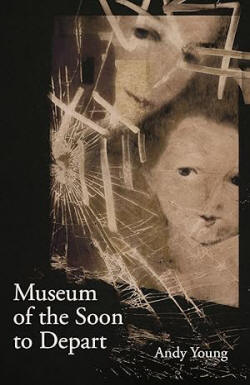
“Shattered” is an interesting meta-like poem serving as
ekphrasis for the cover art by Josephine Sacabo. The piece,
“this mother and child,” is riddled with its “piss-hued
light,” and exposes a missing nose, a key detail suggesting
the beginning stages of losing oneself or perhaps a stark
reminder, not everyone is built the same. About halfway
through the poem a truly magical moment happens. Take a
look:
is it gold or pale yellow
splintering through the glass
where once a bullet
where once a rock
where once a violence
a violin
tried to—did it—pierce through
to their holy rest?
It’s a striking poetic move to turn the repetition into
something new entirely—both violence and violins—existing
in the same world. How one moves through their splintering
is something Young alludes to this closer to the poem’s end:
shattered glass slivers
a shard sticks in the fingertip
you must tip it toward the light
to pluck it out
The subtle movement of the lines toward the center, the
white space of the page, is nuanced, and the sonorous
repetition of the s-sounds is also at play here, too. And
just when you think that you have your breath though,
Young’s close to this poem challenges the notion of
“tip[ping] toward the light” all together. She writes:
no he is not thinking he is counting
the marks our days
through the shattering
he sees us
In this poem Andy Young encapsulates so much so quickly, in
part because of the blurring boundaries indicated by missing
punctuation, but also in part to her poetic genius being put
on display. It’s a revelatory poem in the collection because
of the challenging it does—reconciling with how a child sees
“through the shattering.” It is a truly profound moment in
the book. It made me think of a Poetry Northwest
essay from their “On Failure” series; Nadia Colburn writes
the following: It’s my hope that, despite all our
failures, we can still understand our situation, speak
authentically from it, and act.
Young’s poems “answer” this hope through their ability to
not shy away from the difficulty and shattering but to face
them head-on, and it’s through that vulnerability, something
new comes to the table: strength. This is revealed in
“Second Clinical Trial,” where the speaker’s mother is at
the forefront again. Take a look at this memorable opening:
My brother sends a picture: our mother
holding a tube up through her soft white hat,
smiling. I think she has lipstick on.
She’s just had a hole bored into her skull.
This poem is another example of Young’s attention to detail
and intention to bring those details to life. It’s a
testament to the focus that roots her poetic oeuvre. One of
my favorite lines of the poem is also a favorite in the
book:
…There’s nothing for you
if you don’t have a tether to hope.
The poem captures a fascinating moment in the scheme of
contemporary medical procedures that uses a
genetically-modified version of the poliovirus to treat
brain tumors. The doctor in the poem even quoted to say
“It’s like polio was made/for this purpose.” However, it’s
not without its own complications, as Young writes:
But healing brings swelling.
Two weeks later she’ll black her eye falling,
barely able to shuffle, slurring
from swelling in the parietal lobe.
The repetition of the -ing end sounds starkly, keeping us
readers in the gravity of the situation. Similarly, the
sheer wonder of the ordeal is on display when the narrator
looks over the brain scans:
Something presses against the supramarginal
something or other that tells you where
you are in space and against the spot
that registers empathy. Wait. There’s
a physical location for empathy?
It can be damaged? I don’t know shit.
I don’t know how she has her faith, don’t
know who she’d be without empathy.
The poem is a reflection of the book’s earnestness and
humanity. There’s a bit of charm in that I don’t know
shit line that embraces tenderness in a profoundly human
expression. The first section also explores the worldliness
of the witness Dougherty alludes to in his blurb—taking us
to Barcelona, Cairo, and New Orleans, balancing the tight
rope between the living and the dead—in unrelenting fervor
and attention. It, again, speaks to the significance of
“and” I alluded to earlier and shows us how these
experiences can, because they do, coincide.
One of the sharpest daggers in the collection is housed in
the second section; the poem’s name is “night terror,” and
it’s one of those poems that sneaks up on you when reading a
collection and, before you know what’s hit you, you wonder
why your cheeks are burning.
No?
Just me?
Couldn’t be.
This poem embodies the theme of the museum exceptionally
well. I could very easily see this poem hanging in the
gallery because it’s such a focused, honed-in poem that left
me gasping.
Many of the poems housed in the second section are lensed
with the same embodiment as nearly all of them are some
variations of ekphrasis. One such poem is “Night Walk,”
which takes its title from a dizzying piece by Myrtle Von
Damitz III. The poem, written mostly in couplets, reads:
A parade is coming—no it’s a crowd
flushed back across the bridge. Pregnant
woman, old man, limping child, a tall one whose
skin’s too tight; the bones poke through, obscene.
The painting reminds me intensely of the Dave McKean artwork
housed in Grant Morrison’s Arkham Asylum: A Serious House
on Serious Earth (DC Comics, 1989) with its layering and
complexity. The poem walks us through a hospital-like scene,
riddled with more questions than answers. A call to
attention rather than strictly a call to answer.
Museum of the Soon to Depart
covers a lot of ground—both literally and figuratively—and
demands active attention as a reader. Andy Young’s poetry
functions as both museum and curation. What results is a
truly fascinating collection—one that will undoubtedly stay
with me. |
| Archive | Submissions | About | News |