
~ Delta Poetry Review ~
Book Review by Stephen Furlong
|
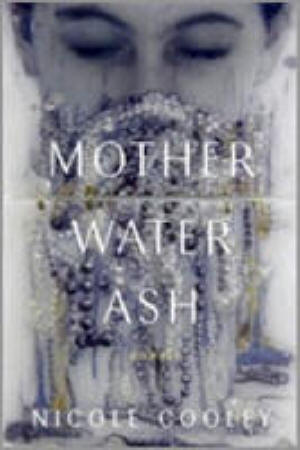
Cooley, Nicole Mother Water Ash:
Poems, Louisiana State University Press 2024.
72 pp. $19.95
Is it possible, then, if the shape is determined that the
shape can be held?
While these questions may have no
answer, it is with great definitiveness that grief is a
shape-shifter; it can fit in small places and, in the same
vein, spill into large spaces, too. These places and spaces
are both undefinable and all-compassing and so when writers
explore grief’s terrain, perhaps it is best to tread
lightly, as to not get lost in a labyrinth of love and loss.
Exploring the cityscape of New Orleans and landscapes of
motherhood and daughterhood, the poems in Mother Water
Ash gain their power throughout the collection to
illustrate that “grief has its own topography”
(from opening poem “On the Mississippi…”). It is
through this illustration that Nicole Cooley reveals her
grief-map, and the poems within become the way toward
healing and understanding in the aftermath of great loss.
An early favorite poem from the book is titled “Missing”; it
is formatted like a series of stairs and lures the reader
into an ever-flowing meditation on grief. In particular, I
was drawn to the minimal punctuation used to illustrate this
meditation. Consider this movement in the middle of the
poem:
fall afternoon air rinsed cold
trees ringed with dead leaves
and I wear her coat
Grief is a river or it’s an animal
sharp-toothed and urgent
When my first daughter was a baby
my mother said–of all I strived to do
that my girl would not remember– She would remember the absence of it–
The recurring ri- and co-
sounds of the first stanza pull readers into the scene and
the rhyme of trees and leaves keeps us there—it’s a subtle
nuance Cooley uses to anchor and engage the moment. These
poetic moves lead to a powerful phrase from the narrator’s
mother: She would remember the absence of it. Before
the poem turns to a close, Grief shows its shape-shifting
ways through multiple phrases before the last one:
…Grief is a metronome clicking on my mother’s piano…
…Grief is the fact that my hands belong to her...
The last one:
…Grief is the fact that her hair
which never grayed
resembles mine
The absence of it.
It’s a captivating poetic move, showing
grief and its multiple avenues, each one riffing off a line
in the hands stanza, “close[er] to the skin.” The return to
the absence line is striking and calculated, and hammers
home the close to this poem.
It should be noted that “Missing” is a
recurring title and houses four more poems of the same
name—thus making five poems in the collection named
“Missing.” Other repetitions also sprout up throughout the
collection; one instance in which Cooley does this is
through “Monochords,” which appears three times in the
collection and is directly influenced by the late Greek poet
Yiannis Ritsos. Mother Water Ash is peppered with
such influences and definitions as the narrator continues to
move through the ever-present grief.
Speaking of “Monochords,” the first iteration of this poem
houses nearly twenty moments that build upon each other for
a truly moving piece. For example:
3.
Grief:
a crape myrtle tree branch snags against my wrist, and I am
ten and
I swallow a chip of my mother’s black soap, a present from
my father, from her
nightgown drawer.
4.
Once breath pressed out of her body.
5.
I hate all the people who still have mothers.
Grief doesn’t hold punches so it’s
fitting that Cooley’s poems do the same—righteous in their
expression of anger and frustration—and they are stronger
for it. The expression is wholly, pulsingly human, and I
found myself audibly gasping at the poetic maneuver.
Similarly, I felt out of breath at these next four
monochords:
9.
Care: a burdened state of mind, as that arising from
heavy responsibilities; worry.
10.
How my mother took care How my mother took care of my
daughters. How my mother—
11.
How we did not know she was dying.
12. Care: charge, custody, keeping
supervision; trust in watching, guarding, overseeing.
Whew! Truly a magical moment that echoes the questioning and the grieving that gets at the heart of the poem. One such echo was the repetition of how—which made me think of the panging of the syllable ow—showcases the question that grief often leaves in its wake. It’s also a testament to Cooley’s wielding of language that two of these monochords are definition-based, which anchors the poem.
The last poem I would like to discuss is “Being the Oldest
Daughter,” which is almost seven poems in one—a poetic grief
collage—and it remains one of the most evocative poems in
the collection because of all the different twists and turns
it takes readers on. Let’s begin:
My mother’s death is another body: she flaunts herself,
takes up too much
space in my bed, ruins my closet, wears my best black skirt,
side-zipped up her thigh. Spins and twirls in my slip,
color of a baby aspirin, color of a dulled sun.
What an incredibly strong opening that
is filled with the all-present grief—truly dizzying in its
execution. In particular, I’m drawn to the verb choice:
flaunts, ruins, takes. These words are cutting and
unnerving as death itself. The dizzying doesn’t stop:
As if now my mother refuses
to be a mother, has no interest in the children who cry for her, demand sippy cups of
milk, want
to settle in her arms in a favorite green chair.
She won’t touch them, refuses every embrace.
The demarcations of safety—“in the children,” “sippy cups of
milk,” “favorite green chair”—are subverted because death is
an ultimate subversion; it leaves those who are grieving
arrested in its wake. One of the separate sections of the
poems that’s stayed with me takes its title from the piece
itself—“Being the Oldest Daughter.”
who gets the texts on her phone: Peace, love, and strength
to you! Thinking of you! Stay strong!
Who is offered gifts of scented bath crystals, body wash.
Important to stay clean and lovely.
Let me know what you need, people say.
Maybe I need nothing.
Another questioning of safety and
comfort because grief challenges those very notions. I was
reminded of a book I read earlier this year, A Truce That
Is Not Peace by Miriam Toews (Bloomsbury Publishing,
2025), in which she writes of a friend who lost a child to
cancer. Her words:
My friend told me she’d never felt more alone and sealed off
in her coffin of grief
than when people told her, even lovingly, even with tender
hugs, that they
couldn’t imagine her sadness.
Try! Stay with me!
In both cases a failure of language
leads to frustration and exhaustion. Often in the face of
grieving is the compelling need to fix, to make clean or
right; I love that Cooley and Toews remind us this isn’t
needed (or even welcomed)! Truly a refreshing approach.
Time and time again, Nicole Cooley’s poems are an anchor in
the sea of grief; the kind of grief that lays bare the
unrelenting force of losing a loved one—through both place
and human connection—and the poems that result are rooted in
details and definitions that anchor us with her and her
collection. |
Nicole Cooley's Poetry and Bio
| Archive | Submissions | About | News |