~ Delta Poetry Review ~
Book Review by Stephen Furlong
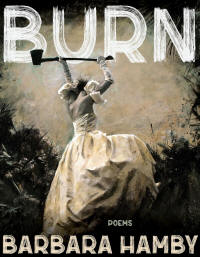
Hamby, Barbara Burn: Poems. University of Pittsburgh Press, 2025. 76 pp. $20.00
Note: Before I begin, I wanted to express my sincere
gratitude to Susan Swartwout and Victoria Olsen and the spirit of Dixon
Hearne. Being able to spend time writing about books for Delta Poetry
Review has been a true joy and I am grateful for the opportunity to do
it again and again. Thank you.
…There must be some way
out of here,
because there is and there isn’t,
barbarbut whatever you do, don’t look back.
from “Ode to the Radio”
Barbara Hamby has worked some magic in her most
recent collection Burn; the collection is riddled and rhymed with odes
that often had me dizzied with reflection and laughter. Of Hamby’s
duality, Denise Duhamel writes in her blurb “[H]er wit and wisdom are
the prizes we dig for in each of her poems as she helps us navigate the
terrifying world of environmental devastation and dangerous political
nonsense.” Simultaneously humorous and hard-hitting, Barbara Hamby has
cultivated an engaging and memorable collection.
From the very beginning, Barbara Hamby pays her
respect to the legends—epigraphs from Sappho, Horace, and even
Endheduanna make an appearance as Hamby, in her own right, “carves her
scheme for the universe.” Like her partner, the venerable David Kirby,
Barbara Hamby writes long, flowy poems that fuse together humor and
heartache—the braiding of which create poems like “Ode to All My
Late-Night Great Ideas.” Hamby writes:
. . .you know the ideas that maybe involve
a road trip
to Miami or California and you wake up in
a parking lot
in Mississippi or Delray Beach with a dead
French fry stuck
to the side of your face or you decide to
drive over
to your ex’s house at 3 am and give him
what your mother
used to call “a piece of your mind”. . .
With line rhymes of
maybe,
Miami, and
Mississippi
alongside the echoing assonance in fry,
side,
drive, and
mind, Hamby is able
to weave a memorable beginning to an enduring poem. The lacking
punctuation also aids in the fusion of humor and heartache too, as the
section continues to unfold:
you won’t remember that psychedelic trip
into the night
or you’ll be able to retrieve the piece of
your mind
from the sidewalk where either he threw it
or you fumbled
It’s a testament to Hamby’s
poetic prowess that both of these moments exist simultaneously in the
poem because they, too, exist simultaneously in life. Once again,
assonance of night
and mind,
retrieve and
piece push
the narrative forward while also pulling in the reader into the world of
words that Hamby is able to cultivate. Before the poem is done, Janis
Joplin, Billie Holiday, and even D.H. Lawrence all make cameo
appearances—furthering the notion of Hamby’s deft ability to engage,
tangle, and entwine memory’s map. The poem ends with some of my favorite
lines from the collection, too, as Hamby writes:
so please, Mr. Postman, keep all my
great ideas in cosmic envelopes
and bring them to me whenever I need to be
shoved out the door with no
idea where I’m going or how or where the
hell I’ll end up
As only the second poem in the book, Barbara Hamby
already had me hooked. There is the ethereal nature of the phrase
“cosmic envelopes” but also the stark reminder of applying action to
memory, words to experience, and her magic is spellbinding. Another poem
which works together rhythm, rhyme, and a bit of magic is “Ode to My
Burning,” where Hamby begins:
You’re a campfire on the outskirts of
Hell, the gas burner
on Satan’s stove, the rigamarole of tinder
and hate
bursting from TV screens. O sister, what
fire rages
in your furnace of tripe and gizzards,
blood and ire?
Right from the beginning with that campfire line,
Barbara Hamby had me entranced—wondering internally (and audibly, too)
“Where is this poem going?” I also have an affinity for poets and poems
that utilize language that is atypical or not as commonplace—I mean, how
many contemporary poems are tossing in rigamarole? Not many, but
consider the word’s definition: “a procedure or explanation that is
long, complicated, and tedious.” And yet, in one of the collection’s
shortest poems, Hamby’s lines unfold in dramatic fashion:
. . .Oh yeah, you’re crisp
as a deep-fried corndog on the last day of
the circus
when the high flyers come down from the
trapeze,
and the clowns take off their noses, bury
them
in a dump by the radioactive lake, while
you sleep with the lions,
who have ditched their wigs to dream in
caravans
of squalor and storm. . . .
One detail I’d be remiss to
bring to attention is the auditory experience of a Barbara Hamby poem.
Yes, there is further line-based rhyme and movement which I alluded to
earlier, but also the consonance of crisp,
corndog,
circus,
come, and
clowns
alongside down,
dump,
ditched, and
dream really makes
this poem sing in a profound way. The poem ends in spectacular fashion;
consider this:
because you’re burning on your cross again
like Apollo
for Daphne, his fingers touching her skin
as it thickens and turns,
but you’re Daphne, too, as your arms
become bark
and the dark pith of sap rises in your
womb, and you see
the earth for what it is—a river, a bell,
a tomb.
What an ending! The classic Daphne and Apollo
mythology ends this poem in stunning fashion.
Brief lesson: Apollo, Daphne, and Eros (also known
as Cupid) all play center stage in this story. Apollo, in this story, is
oft associated with ego and unchecked lust; Daphne is stunning and
beautiful, but rejects men’s advances for all time; Eros, in a way,
serves as the checker and balancer, but is also spurned into action
because of his own hurt. Two arrows get shot—one causing passion and one
deterring it. Then, after a pursuance, Daphne turns to a laurel tree.
Not lost in future translators is the symbolism of wisdom and victory
the laurel represents.
The mythology fuels this poem to new heights because
the speaker is simultaneously pursuing what (and who) they love, but
also recognizing their own “Daphne” attributes—to be untouchable and,
pun intended, also rooted in that. The poem, alongside its mythology
allusions, is layered and nuanced and proves to be a favorite of mine.
Sidebar: At the end of
Burn, Barbara Hamby
offers up an explanation for writing a collection of odes; she posits
“[U]nlike the elegy that focuses on the end of lives, the ode celebrates
and contemplates living, but, of course, that means keep an eye on the
final curtain as well, so there’s an elegiac subtext in every ode.” It
is through this awareness that, for myself as reader and writer and
human, there’s an understanding, an agreement of sorts, ending exists
alongside living and celebrating. How fitting then to have this
collection right now!
The last poem I’d like to touch on is housed in the
last section, and that is “Want Ode.” Take this snippet from the second
stanza and a teeny sliver of the third:
but I want to be those flies buzzing like
a fire alarm at 3am,
my brain blazing and my body following
like a hungry dog,
walking through a city where I don’t speak
the language,
every word a slap in the face or an
invitation to a party
in a deserted mansion where the dictator
beheads the poet,
and his wife stabs him in his bath, eats
blood oranges
and weeps. . . .
Another wonderful example of Hamby’s utilization of
the long, flowy line and another poem that doubles as masterclass
auditory wielding. The tone of this poem is so rich in its humanness,
too, to be among the living but also teetering and tottering over
uncertainty and celebration. This, too, reminds me of “Ode to My
Burning” in that sense and reveals how both co-exist. Rooted in ode’s
legacy, Byron makes an appearance, so too does Beethoven. For example:
I want to step into Beethoven’s filthy
apartment with the pizza
boxes stacked on the floor and listen to
him pound
his piano into splinters. I want to be the
splinters and the pain
in his gut that becomes the opening of the
Fifth.
I love that splinters and pain line. It, too, is
rooted in history’s lessons made modern; contemporary research reveals
that in addition to going deaf, Beethoven also had significant
gastrointestinal problems, among other ailments. While this section is a
classic “pain into art” trope, there’s something more to it. Consider
these lines, as we consider the speaker here as both intensely craving,
but also self-aware.
I want to be the immortal beloved, to
smell your body
when I first knew you wanted me, that same
yeasty pong
that drove me mad with desire, because I
want to stop time,
start time, make time, pass time, want to
blow my past
to smithereens and still remember
everything in Technicolor detail,
so I’m asking when will this wanting stop.
. .
You know what I want?
I want to thumbtack these words to telephone lines
and hang it in art galleries.
I truly love these lines.
All told, Barbara Hamby’s
Burn is full
of that—lovely and powerful lines, stop-you-in-your-tracks lines. It’s a
collection rooted in the historical legacy of ode but also one that
pushes the boundaries of what an ode can be in this social, poetical,
and political climate. It’s a collection for our time and of our time
and truly deserves a place on your bookshelf.
Barbara Hambry's Poetry and Bio
| Archive | Submissions | About | News |