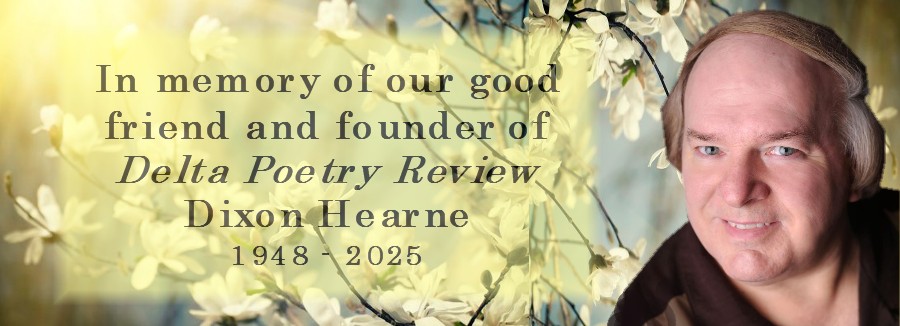
~ Delta Poetry Review ~
Kelly Whiddon
Guide to the Southern Magnolia
I used to love it, its leaves like wax,
its double blossoms of white
saucer petals—like faces.
When pruned at the base,
it is great for climbing. I used
to scale its speckled branches,
smell the heady mix of sweet
and earth, so high that the limbs
at my perch were thin,
their scrawny forks just big enough
to squeeze in a small foot, sway
with my own weight, my head popping out
of the top branches like a birth.
I remember looking out and down—
the world my campus–what a luxury,
what a privilege to be at its top.
I mean, it existed before the bees,
which suggests, ironically,
that it is older than puberty,
a stage that came for me,
about the time I stopped
climbing trees.
The oldest tree on the grounds
of the White House is a southern
magnolia planted in the 1830s
by Andrew Jackson, who made
his fortune through slavery
on his cotton plantation, the one
that produced the seedling
for that tree. I imagine them,
his slaves, at his home,
the Hermitage,
in the fields, sweating,
blistered skin, looking
up at the birds perched
on magnolia branches, singing, primed
to fly but instead just swaying
swaying swaying with the limbs.
The Victorians believed
it symbolized nobility,
but it has come to mean
more: new beginnings,
endurance, longevity.
Last year, New Orleans police
caught surveillance of a thief,
a man on a bike stealing a 3-foot
magnolia tree right out of the ground,
roots and all, in front of a public
building—just rode up, plucked it
from the dirt, and rode away
in the night, tree balanced on his thighs.
There was no violence, no anger—
I’ve seen the video—
just a claiming, or a reclaiming,
a thoughtful haul, peddling
away like Mary Poppins
on a spring day or Butch Cassidy
carting his friend’s girl
on the handlebars
to a Burt Bacharach
melody, hearing
that refrain buzzing
or chirping or warbling
through his brain:
because I’m free,
nothing’s worrying me.
Haunted Pub Crawl
We spent a weekend walking in Savannah
and one night took a guided tour of haunted pubs
because hanging out with blitzed ghosts
seemed like a fun thing to do.
Our guide, who daylighted as a pirate waiter,
told us their drunken confessions:
the riverfront ghosts believed God kills us when
we get bored, and Confederate ghosts
could feel their bones straining against
their imperfect hearts, jacked-on-whisky
and gangrene.
I could never hold my liquor, so I held
your hand, eating up the denim sky as it
filtered
through the old curling tree branches that
dipped
down onto park squares.
Our guide said to watch out; brick mason ghosts
could fall like apples through the third floor
taverns. He said their bodies were buried under
the cobblestones and scotch bonnet shells
beneath our feet.
And in the courtyards at night, girl scout
founder
Juliet Gordon Low’s ghost danced with the ghost
of jazz age crooner Johnny Mercer, each knowing
that pain is a way to wake us up, and bliss is
something
to carry, for protection, like a song.
What did we know of how the past blurs
into future, of how life’s pains
could make us feel like Shanghaied sailor
ghosts on schooners, watching the land drift
away,
their hearts a dream they waved to on the shore?
In all, it seemed the night was singed by souls
lost
to this city, and we touched timidly,
as if a graze could suck us
into the sozzled dead.
It couldn’t.
Your warm digits, your rummy breath: they
were as rousing and alive as the young history
between us, as potent as the phantoms
up ahead.
Kelly Whiddon
has published in Cimarron Review,
Southeast Review,
Meridian,
Crab Orchard Review,
Slipstream,
and Summerset Review,
among others. Her book The House Began
to Pitch (Mercer UP) was honored with
the Adrienne Bond Poetry Award. She teaches English and creative
writing at a small university in Macon, Georgia.
| Archive | Submissions | About | News |