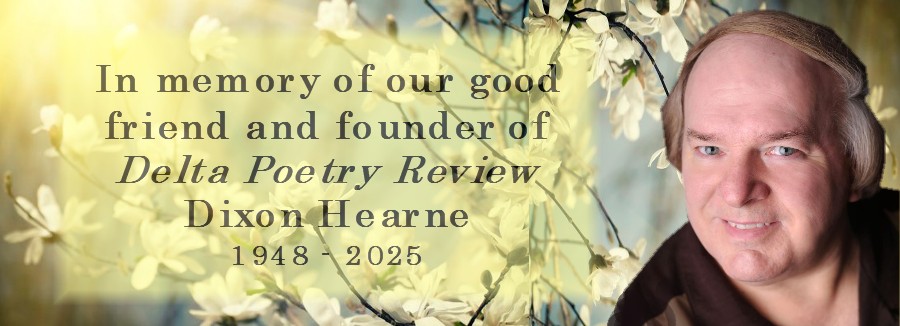
~ Delta Poetry Review ~




Memories of James Dixon Hearne
March 17, 1948 — May 24, 2025
Sterlington , LA
|
I first encountered Dixon Hearne after he sent a letter to me at the university where I teach (yes, it was actually a paper letter, which I still have tucked away into a copy of Dixon’s book Plantatia). He told me that he’d just read my second novel, Harlow, which is a semi-autobiographical story about a young boy searching for his father. He talked about how moved he was by the story and offered to review it for the Southern Literary Review. I wrote him back and told him I’d be honored to have him review my book, and from then on, a sort of literary friendship was formed. Our conversations about books and art and other writers were always refreshing, and I was amazed by Dixon’s breadth of knowledge when it came to literature—his aesthetic sensibility was unparalleled, as was his devotion to the arts and the people who make it. His loss leaves a great hole in the literary community and he will be deeply missed. However, I’m happy to know that his legacy will continue to live on in the writers and artists whose lives he changed with his generosity of spirit and his caring heart. —David Armand I never had the pleasure of meeting Dixon in person, only online. But doesn’t that show the value of relationships made across distances? I knew he was a great supporter of Southern writers. And I was so grateful, especially as a younger writer, when he reached out to invite me to send work to DPR.
—Denton Loving Passing June 29, 2025. A sad day as I received an email
from Dr. Susan Swartwout that Dixon Hearne passed away unexpectedly
at his home a month ago. road to paradise memories
tag along Dixon and I never met in
person. We sent emails occasionally over the years as editors and
submitters. In 2007, Dixon sent me his short story, “Right Eye of
Justice,” which appeared in the spring 2008 issue of
Valley Voices.
In 2012, we republished the story in a special issue that celebrated
the journal’s tenth anniversary. In 2013, Dixon sent me another
story, “The Pang of Patience,” to grace the fall 2013 issue of
Valley Voices.
writing break his name summersaults in the mind As
editor, I am grateful to writers who support our journal with fine
creative works. Dixon was such a fine writer. Six years after the
publication of his second story, he returned with a review of Philip
Kolin’s Reaching Forever.
Later in the same year, I invited him to
review James Fowler’s The Pain Trader,
and he did it, though he was sick. His email of December 2, 2020
reads, “I’ve been backlogged
due to a series of illnesses, including COVID. I’m finally getting
caught up and should be able to get the review to you before the end
of the month.” He was a real trooper who supported with a warm
heart. afterglow choreography of starlings delights the eye Dixon became my editor in
2020 when he published three of my poems in
Delta Poetry Review,
a fine online journal he founded in 2019. Since then, my work has
appeared in the journal every year. As a poet living in the
Mississippi Delta, I am thankful to Dixon, the dedicated founder and
editor of Delta Poetry Review,
which has showcased poetry that captures the essence of the place,
culture, and dialect of the Delta region and
the American South. his dedication a petroglyph engraved in the rock
I first met Dixon Hearne by telephone in early 2002, when he reached out from his home in California to offer his help with the Gulf Coast Writers Association in Gulfport, Mississippi. He generously volunteered to assist in creating and editing an anthology of our members’ stories. That call was the beginning of a remarkable creative partnership and a cherished friendship. Over the years, Dixon and I collaborated on multiple anthologies, blending our talents to bring other writers' voices to life. I also had the privilege of working with him on his own books—editing, designing covers, and building a website that highlighted his prolific career as a writer and author: www.dixonhearne.com. Several years ago, after Dixon retired from teaching, he called with great excitement. He had always dreamed of starting an online poetry journal and asked if I would help bring that vision to life. That conversation led to the creation of Delta Poetry Review, which was initially intended as a one-time publication. But poems flooded in, and Dixon’s passion grew. Thanks to his dedication, the journal became an enduring space for poets to share their work: www.deltapoetryreview.com. Although Dixon and I never met in person, we spoke often and shared a deep connection. I considered him one of my dearest friends—steadfast, kind, and deeply supportive. He had a generous spirit and always spoke with warmth and admiration about the many writers and poets he championed. His absence leaves a void in my heart and in the literary world he so loved. —Victoria Hobbs Olsen |
Dixon and I met, virtually, over ten years ago when he requested that I read his Southwestern poems and consider writing a blurb for the forthcoming publication of his manuscript. I had been familiar with much of his published work for several years, and found his Southwestern manuscript most impressive. Although I, unfortunately, never had an opportunity to meet him in person, I felt that I knew him very well through our extensive correspondence over many years. Approximately eight to ten years ago, being of deep Southern heritage, I decided to devote my literary efforts to the writing and publication of my Southern verse, especially that of the Mississippi River Delta. Hence, when Dixon announced the publication of the Delta Poetry Review, I began to submit poetry to the journal for publication consideration. Dixon was not only gracious to publish a large number of my poems in DPR but also invited me to be the featured Southern poet for his February 2021 issue. Of the many national Southern literary journals in which I have been able to publish my work, I value none of them more than Dixon’s Delta Poetry Review. Dixon not only left an indelible mark on Southern letters but was also a quintessential Southern gentleman in the very best sense of the term. I shall always regard him as one of the closest mentors and friends I have been privileged to know in my entire adult life. —Larry D. Thomas
I am so sad at the news about Dixon’s passing. The thing that struck me most about Dixon was that, as a well-published author himself and a journal editor in a position to wield power over other writers, he was always so admiring and supportive of other writers and so humble about his own talents. When he asked me in 2016 to blurb his book Plainspeak and I said yes, he replied that he was “thrilled” that I was “willing to read this collection.” When he chose me as a featured poet for Delta Poetry Review in 2021, he said, “I have great admiration for all the wonderful poets I’m able to include in each issue of the journal. It soothes my apprehensions about taking on the challenge.” Later, he wrote to me that “There are so many wonderful poets out there, I want to help promote them.” Martin Luther King Jr. once said that “Life’s most persistent and urgent question is, what are you doing for others?” Dixon stands among those whose service to others was a shining answer to that question.
—Julie Kane I didn’t know Dixon well in person, but have had quite a bit of correspondence with him over the years and greatly appreciate what he did for Southern writers by creating Delta Poetry Review. He was also a great correspondent. I will look back over our emails and try to write something more personal. In doing so, I saw that he published in Poetry South in 2017 before he started DPR, and that he was very interested in the Welty Symposium. In Feb. 2020, he promised he would come in person, but we all know what happened that year. He was a very generous and thoughtful guy. It’s still hard to believe he’s gone.
—Kendall
Dunkelberg Dixon was one of those literary angels who not only wrote and had published a large body of his own work but who also supported many, many other writers and Southern literature in particular. My own correspondence with Dixon began when he submitted short stories to Big Muddy: Journal of the Mississippi River Valley. After I published a few of his stories—to acclaim from readers and my wonderful and discriminating assistant editors, Mandy Henley and Donna Essner—I asked him if he had enough stories for a book collection, and yes he did. I’m proud that his book Plantatia: High-toned and Low-down Stories of the South, was published by the university press. We later published his novella, From Tickfaw to Shongaloo, a tender valentine to the vagaries, gossip, and jargon of a small Southern town. Dixon also encouraged other Southern authors to submit their work to the university press, and he sponsored two Big Muddy short story contests (one in the name of his beloved mother, Wilda Hearne) and a full-length poetry contest dedicated to Vern Cowles. I first met Dixon in person when I invited him to do a reading of his work and to meet with upperclass and graduate creative writers at our university. He was quiet, a little shy, but the information and encouragement that he gave our students had them talking for months about his visit. In 2019, Dixon founded Delta Poetry Review with the assistance of his friend, Victoria Hobbs Olsen, past president of the Gulf Coast Writers Association and DPR webmaster. He showcased some of the South’s finest writers and their thoughts in the featured poet section of each DPR issue, and gave hundreds of other poets the opportunity to share their work in DPR’s online journal. We lost a dear friend and a stalwart supporter of Southern literature. He is greatly missed. —Susan Swartwout Dixon
Hearne was a one-of-a-kind Master of every form of
poetry and prose extant. He was also the most humble writer
I have ever met. Not to mention the sweetest and most
helpful, always with a smile. He was like a brother sitting
next to me while we completed the PhD program at Claremont
Graduate University in Claremont, California. He had the
same low threshold for humor that I had, so laughter was
almost continuous. We did a lot of readings together, and a
lot of workshops for all ages, from kindergarten to
post-graduate. Please take advantage of his many gifts and
read everything he wrote.
—Olivia
S. Ellis |
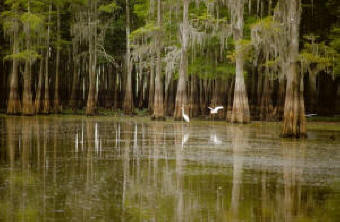
Poems from
Plainspeak
by Dixon Hearne, Kelsay Books (2016)
River of Life
A drop, a trickle, a rivulet—
—from womb of
Misi-ziibi
Great River
Big Muddy
Mississippi
wending its way
from frozen regions
through grassy plain
and river wood,
sauntering southward,
shifting shape
with curve and rise
and lonely swale,
ever onward, gathering tales
along its fabled journey—
defying effort to control its whims,
vexatious eddies and sandy shoals
daring boat and barge
to run the gauntlet,
course its might, teeming waters
rich with mud cat,
gar and goo,
bleeding color, tans to reds
to ochre swirls
at its gaping mouth.
Historian, scholar,
teller of tales,
keeper of secrets,
giver of life,
a thing of treachery,
a thing of grace,
eternal graveyard
of plans and quests,
a river of dreams
a float of promise
until all hope
has drained its veins
some distant age
beyond.
We Thrive
Along the bayou traces,
woodland thickets,
all along the river’s bend
beyond the eye’s purview,
our people have lived and thrived.
Brought up from the underworld
and given breath,
we learned the river’s ways,
the bayou’s gifts and dangers.
We are too many generations
rooted in brown and ochre marsh
to flourish in other soil.
Our ways are captured
in the elders’ tales
passed from age to age:
of tribal battles
to save our kind—
Caddo, Choctaw, Tunica,
keepers of Mother Earth,
hunters of the wood,
fishers of the waters,
planters of the field.
Survivors of the angry storms
blown up from southern shores
that swell our rivers,
surge and tear asunder.
Survivors of the summer wilt
and sting of winter,
pangs of bitter illness
that ravage weak and old.
And through the scourges,
fear and malice,
we thrive still—
strong hearts
against the ceaseless
tides of change.
Delta Deep
The eager breath of autumn stirs the branches,
tickling leaves into submission—
a final fling before the fall.
Deep skies arc, stretch taut
in cool blue hues and faint gray smudges.
Summer quivers in shadows of waning glory,
moaning the loss of emerald brilliance.
Star-crossed toilers born to the land,
tethered to the plow and cotton sack
mark the season’s coming
with guarded hopes—and
restless hearts sown Delta deep.
The Catch
Black-eyed and staring
through bracken waters,
body shimmering iridescence—
eight pounds, maybe more—
line draws taut, gyrating,
whirring water to a froth,
fins tacking north
as I pull south.
Caught and strung,
still flapping for freedom.
Cottonmouth edging for an easy catch—
eyes bigger than his belly—
strikes twice, missing his mark,
then warned away with paddle blade.
Three more tussles
yield a mess for frying,
enough to feed a brood of six—
fried golden crisp
over open fire
in a ripe Dutch oven
with rancid grease
made fresh again
by Russet fries.
Folks live or die by their catch—
sales to the fish houses,
markets, and roadside stands,
competing for skinflint sums
scarce as manna on the bayous.
Traveler
I am alone here
on the road to nowhere.
Come along
and take a seat beside me.
Raise your mug
and greet a fellow traveler.
Hold me at heart’s distance—
the trip is brief
and ever fickle.
| Archive | Submissions | About | News |